

Choosing the right technology foundation is one of the most defining decisions a growing business will make. Many organizations today find themselves comparing custom software vs SaaS as they evaluate what will best support their long-term goals. Both paths are valuable, both power modern businesses, and both have real implications on scale, cost efficiency, and operational control.
While SaaS offers fast onboarding and predictable costs, custom software development provides deep flexibility and the ability to build systems that work exactly the way your business operates. The challenge lies in recognizing which approach aligns with your operational reality, team structure, and growth horizon. This guide breaks down the essentials to help you make a confident, well-informed decision.
Understanding SaaS and Why It Works for Many Teams
SaaS platforms deliver convenience. They offer quick setups, regular updates, and a user-friendly experience that helps teams get started without technical complexity. For early-stage companies or organizations with simple processes, SaaS solutions reduce friction and streamline adoption.
SaaS is especially useful when you need something ready to use, when you do not want to manage infrastructure, or when you want predictable subscription costs. As one of the most popular business software options, SaaS remains a strong fit for teams who do not require heavy customization.
Where SaaS Faces Limitations?
SaaS platforms follow a one-size approach. This can restrict fast-growing companies with unique workflows or compliance needs. Integrations may require additional tools, and feature gaps can slow down teams as operations become more demanding. SaaS helps you move quickly, but it may not always move in the direction your business is evolving.
Understanding Custom Software and When It Becomes the Better Choice?
Custom software development focuses on building technology that mirrors your business rather than the industry standard. Every feature, workflow, and experience is built with intention. This allows companies to differentiate, innovate, and create systems that serve their exact needs.
Custom systems offer stronger long-term value because they integrate deeply with existing tools, create operational consistency, and reduce dependency on third party vendors. When used effectively, custom software can produce higher software ROI and deliver a lasting competitive advantage.
Where Custom Software Needs Care?
Custom solutions require upfront planning, ongoing maintenance, and a committed technology partner. They are an investment, but one that grows in value as your business expands and evolves.
Start by Evaluating Your Operational Complexity
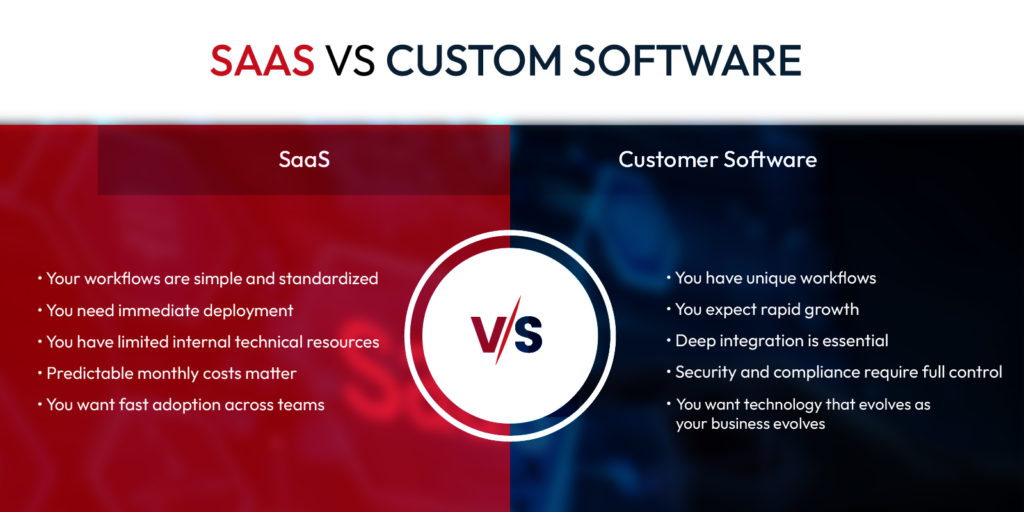
Before choosing between custom software vs SaaS, it is important to consider how complex your operations are. Businesses with unique processes, multilayered approval chains, or specialized compliance needs tend to outgrow SaaS platforms quickly.
Custom systems give you complete control, allowing technology to support how you work instead of forcing teams to adapt to rigid structures.
- Low complexity may fit SaaS better
- High complexity often demands custom solution
Look at Your Growth Horizon
Technology decisions should support where your business is heading, not only where it is today. If your roadmap includes rapid expansion, new markets, or advanced automation, custom software becomes a safer long-term investment. SaaS supports early growth, but its limitations often surface when scalability becomes a priority.
- SaaS helps teams begin quickly
- Custom software supports the next stage of maturity
Consider Your Integration Requirements
Most organizations rely on diverse tools across operations, sales, finance, logistics, and customer experience. Integrating these tools into a single connected system can be challenging with standard SaaS products.
Custom solutions give you the freedom to design an architecture that brings everything together, whether you are using legacy tools or modern cloud-based systems.
Understand the True Cost Beyond Year One
SaaS appears cost efficient at first glance. However, subscription-based pricing often increases as your user base grows, and premium features can create additional expenses. Custom software requires deliberate investment but becomes more cost effective over time, especially when you need scalable software designed for your specific use case.
- SaaS creates ongoing operational expense
- Custom software becomes a long-term asset
Making the Right Decision with Confidence
Choosing between custom software vs SaaS is not about which approach is better overall. It is about which approach is right for your business model, your operational needs, and your future.
At Invisia Software, we guide organizations through this decision by analyzing workflows, long term goals, integration needs, and growth plans. Whether you need custom software, SaaS integration, or a balanced hybrid model, our goal is simple: help you build technology that supports sustained, meaningful growth.
When your software is designed with intention, it does more than solves problems. It becomes the foundation that helps your business move faster, innovate confidently, and unlock new possibilities.