

APIs are the backbone of modern digital platforms. From mobile apps and SaaS products to financial services and enterprise tools, APIs enable systems to communicate and share data seamlessly. As organizations adopt microservices, containers, and distributed architectures, cloud-native systems have become the standard for scalable and flexible application development.
However, this shift also increases the complexity of managing API security. In cloud-native environments, APIs are constantly interacting across multiple services, platforms, and environments. Without a structured approach to protecting them, vulnerabilities can quickly spread across the ecosystem. At Invisia Software, we help organizations design, deploy, and maintain secure APIs that support modern cloud-native infrastructure while maintaining strong security standards.
Why API Security Matters in Cloud-Native Environments
Cloud-native architecture allows businesses to build scalable applications that evolve quickly. Microservices communicate through APIs, enabling independent components to interact efficiently. While this approach improves development agility, it also expands the potential attack surface.
Each cloud-native API becomes a potential entry point for malicious activity if proper safeguards are not in place. Weak authentication, poorly secured endpoints, or misconfigured permissions can expose sensitive data or allow unauthorized access.
Organizations therefore need a robust API security strategy that protects data while maintaining the performance benefits of cloud-native systems. Invisia Software works closely with engineering teams to implement security frameworks that protect APIs without slowing down development cycles. By embedding security into the architecture itself, businesses can confidently scale their platforms while maintaining secure APIs across their environments.
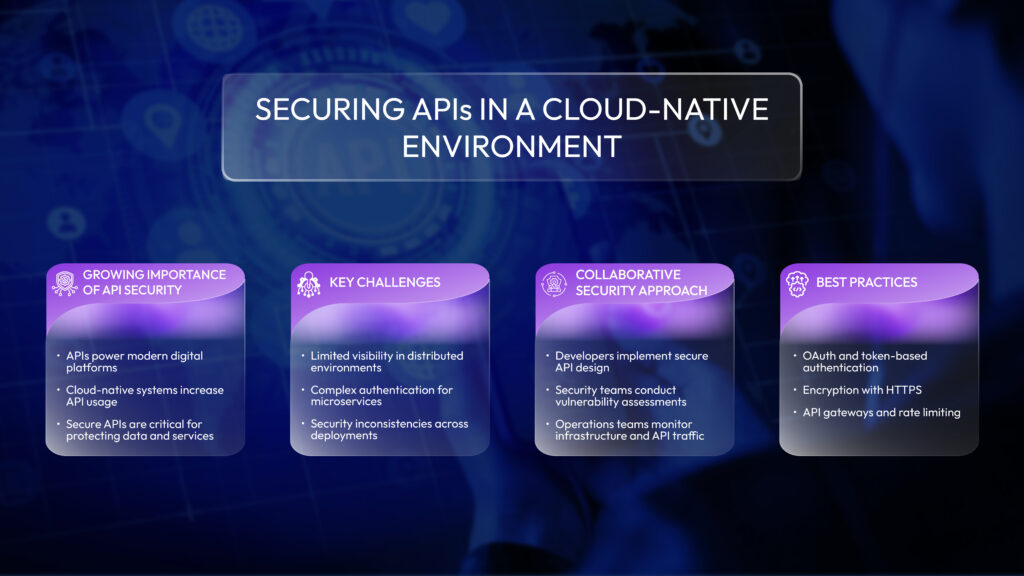
Key Challenges in Securing Cloud-Native APIs
While cloud-native systems offer flexibility and scalability, they also introduce unique security challenges that traditional infrastructure was not designed to handle.
One major challenge is visibility. Cloud-native environments often involve hundreds of microservices communicating through APIs, which makes tracking traffic patterns and monitoring endpoints more difficult. Without centralized monitoring, potential threats may go unnoticed.
Authentication and authorization are also more complex. Service-to-service communication requires strong identity verification mechanisms to ensure that only trusted systems can access sensitive data. If these controls are poorly implemented, attackers may exploit the gaps.
Configuration management is another critical concern. APIs may be deployed across multiple environments, cloud providers, or regions. Maintaining consistent security policies across these distributed systems requires careful coordination and expertise. Invisia Software helps organizations address these challenges by implementing unified security frameworks that ensure every cloud-native API follows consistent protection standards.
Building Secure APIs Through Collaboration
Effective API security requires collaboration between development, security, and operations teams. Instead of treating security as a final step, organizations must integrate it throughout the entire development lifecycle.
Developers play a vital role by designing APIs with secure coding practices. This includes validating inputs, protecting endpoints, and implementing authentication protocols from the start. Security teams then evaluate potential vulnerabilities, conduct audits, and establish access policies that protect sensitive systems.
Operations teams support these efforts by managing infrastructure, configuring API gateways, and monitoring traffic patterns to detect anomalies.
At Invisia Software, this collaborative model is central to how we help clients build secure APIs. Our teams work alongside engineering and operations teams to integrate API security into DevSecOps workflows. By aligning development speed with security best practices, organizations can deploy cloud-native APIs confidently while maintaining strong protection against evolving threats.
Conclusion
As cloud-native technologies continue to transform digital infrastructure, APIs will remain central to how applications communicate and scale. Protecting them requires more than isolated security tools. It requires a structured, collaborative strategy that combines secure development practices, infrastructure monitoring, and continuous threat detection.
Organizations that prioritize API security early in their cloud-native journey are better positioned to scale safely while maintaining trust and reliability. With the right expertise and security frameworks in place, businesses can confidently build and manage secure APIs that support long-term growth.
Let’s discuss how we can work together to secure your APIs.