
Software development is evolving faster than ever, and AI is no longer a “future concept” waiting in the wings. It is already changing how products are designed, built, tested, and scaled. For organizations willing to embrace it thoughtfully, AI software development is not just about speed or automation. It is about building smarter systems, empowering teams, and creating products that adapt in real time to user needs.
At Invisia Software, we see AI as a collaborative force rather than a replacement for human expertise. When combined with strong engineering fundamentals, domain understanding, and clear business goals, AI becomes a powerful enabler that helps teams do their best work, faster and with greater confidence.
Rethinking the Software Development Lifecycle with AI
Traditional development cycles often struggle with inefficiencies. Requirements change, technical debt builds up, testing takes longer than expected, and scaling introduces new complexities. AI software development helps address these challenges across the lifecycle.
During planning and design, AI-driven insights can analyze historical project data, user behavior, and system performance to support better architectural decisions. In development, AI-assisted coding tools help engineers write cleaner, more consistent code while reducing repetitive tasks. For testing and QA, intelligent automation can identify edge cases, predict failure points, and significantly reduce regression testing time. Even post-deployment, AI can monitor systems continuously, flag anomalies, and suggest improvements before issues impact users.
This shift allows development teams to spend less time reacting to problems and more time building meaningful features.
Why AI Matters for Startups and Growing Teams?
For early-stage companies and fast-growing businesses, AI for startups can be a game changer. Limited resources, tight timelines, and pressure to innovate often collide. AI helps level the playing field by increasing productivity without proportionally increasing team size.
Startups can use AI to accelerate MVP development, validate ideas faster, and adapt products based on real-time feedback. At the same time, established organizations can modernize legacy systems, improve scalability, and future-proof their technology stack. The key is applying AI with intent, not as a shiny add-on but as a strategic capability aligned with long-term goals.
Where AI Creates the Biggest Impact in Software Development?
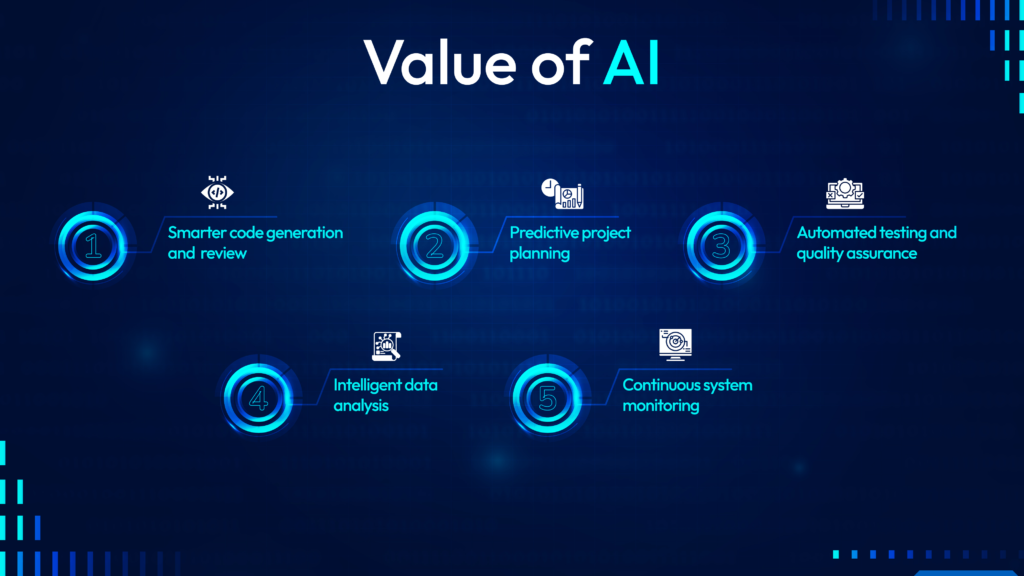
This is where AI’s value becomes especially tangible. When applied across the right touchpoints, it transforms both process and outcomes.
- Smarter code generation and reviews that reduce errors and improve maintainability
- Predictive project planning that identifies risks, dependencies, and delays before they escalate
- Automated testing and quality assurance that adapts to changing codebases
- Intelligent data analysis that turns user behavior into actionable product insights
- Continuous system monitoring that improves reliability, performance, and security
This combination of speed, intelligence, and adaptability is shaping the future of AI in software in ways that were not possible just a few years ago.
Building AI-Driven Software, Together
The real power of AI software development lies in collaboration. AI works best when guided by human judgment, creativity, and context. At Invisia Software, the focus is on integrating AI into development workflows in a way that supports teams rather than overwhelming them. That means choosing the right tools, defining clear use cases, and ensuring AI solutions remain transparent, ethical, and scalable.
Reshaping software development is not a one-size-fits-all journey. It is a partnership that evolves with your product, your users, and your business objectives. By working together, it becomes possible to unlock AI’s potential while staying grounded in strong engineering practices.
Let’s discuss how we can transform your software development with AI.