

AI-powered apps are no longer experimental side projects. They are becoming core to how modern software is built, scaled, and experienced. From recommendation engines and chatbots to fraud detection and intelligent automation, AI is now a practical layer in everyday app development rather than a futuristic add-on.
For developers, this shift brings both opportunity and complexity. The tools are powerful, but the path from idea to production-ready AI-enabled application requires thoughtful planning, the right architecture, and a strong understanding of how AI fits into the broader development lifecycle. This guide breaks down what developers need to know to build effective, scalable AI-powered apps.
Understanding What Makes an App AI-Powered
An AI-powered app is defined by its ability to learn from data, adapt to user behavior, and make predictions or decisions with minimal manual rules. Unlike traditional logic-driven applications, AI-driven systems rely on models that evolve over time.
In app development, AI can be embedded in several ways. Some applications use AI for user-facing features such as personalization or natural language interactions. Others use it behind the scenes for tasks like anomaly detection, demand forecasting, or workflow automation. The key is identifying where intelligence genuinely adds value rather than forcing AI into places where simpler logic would suffice.
Choosing the Right AI Use Case Early
Before writing a single line of code, developers should clearly define the problem AI is expected to solve. Successful AI-powered apps typically focus on one or two high-impact use cases rather than attempting to automate everything at once.
Questions worth answering early include what data is available, how accurate the predictions need to be, and how the system will behave when AI confidence is low. Clear answers help avoid overengineering and reduce costly rework later in the app development cycle.
Data Is the Foundation
AI is only as good as the data it learns from. Clean, relevant, and well-structured data is essential for building reliable AI-powered apps. Developers often underestimate the time required for data preparation, labeling, and validation.
It is also important to think about data pipelines early. Real-time apps may need streaming data, while others can rely on batch updates. Privacy, compliance, and data security must be designed into the system from the beginning, especially when handling sensitive user information.
Selecting AI Tools for Devs
The current ecosystem offers a wide range of AI tools for devs, from open-source frameworks to managed cloud services. Libraries like TensorFlow and PyTorch give full control over model development, while APIs for vision, speech, and language processing can significantly reduce build time.
The right choice depends on the team’s expertise, scalability requirements, and maintenance capacity. Managed tools can accelerate delivery but may limit customization. Custom models offer flexibility but require ongoing monitoring and optimization.
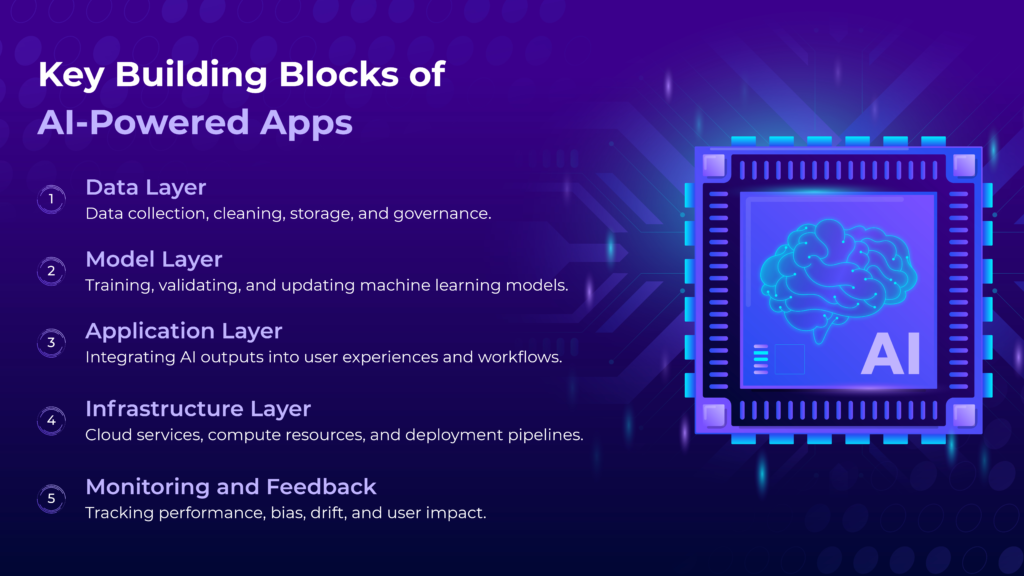
Integrating AI Into the App Architecture
AI should be treated as a modular component rather than tightly coupled logic. Many teams expose models as services through APIs, allowing apps to consume predictions without being tied to specific implementations.
This approach improves flexibility and makes it easier to upgrade or replace models over time. It also supports experimentation, enabling developers to test new models without disrupting core application functionality.
Testing, Monitoring, and Iteration
Traditional testing methods are not enough for AI-powered apps. In addition to functional testing, developers must monitor model accuracy, response times, and real-world behavior after deployment.
AI models can degrade over time as user behavior changes. Continuous monitoring and retraining are critical to maintaining performance and trust. Logging predictions and outcomes helps teams understand where models succeed and where improvements are needed.
Building Responsibly and at Scale
Responsible AI practices are becoming essential in modern app development. Developers should be aware of bias, explainability, and ethical considerations, especially in applications that affect decisions, access, or outcomes for users.
Scalability is another key factor. AI features that work well in small pilots must be designed to handle production traffic without latency or cost overruns.
Where Invisia Software Fits In
At Invisia Software, AI-powered app development is approached with a strong balance of engineering discipline and practical innovation. The focus remains on helping teams integrate AI in ways that are scalable, secure, and aligned with real business needs, without unnecessary complexity.
Whether supporting architecture design, model integration, or intelligent automation, Invisia works alongside development teams to ensure AI becomes an enabler rather than a bottleneck.
Final Thoughts
Building AI-powered apps is not about chasing trends. It is about using intelligence thoughtfully to solve real problems and improve user experiences. With the right use cases, data strategy, and AI tools for devs, developers can create applications that learn, adapt, and scale with confidence.
Let’s explore how AI can enhance your app development.