

In today’s hyper-competitive digital ecosystem, launching a SaaS product is easier than ever. Scaling it sustainably is the real challenge. While many startups gain early traction, only a few manage to build a truly Scalable SaaS business that grows predictably without spiraling operational costs.
So what separates high-growth SaaS companies from the rest? Industry leaders point to a combination of strategic pricing, product-led growth, customer-centric design, and technology architecture that supports long-term expansion.
Let’s explore the core pillars behind successful SaaS business models and what startups can learn from them.
1. Product-Market Fit Comes First
Before thinking about scale, leading SaaS founders obsess over product-market fit. Without a clear and urgent customer need, scaling only magnifies inefficiencies.
Successful SaaS companies continuously validate their assumptions, gather user feedback, and refine their product to solve a specific, high-value problem. For SaaS for startups, this stage is especially critical. Startups often face limited resources, so aligning product capabilities with market demand ensures sustainable growth instead of short-lived spikes in user acquisition.
Industry leaders recommend focusing on:
- Solving one core problem exceptionally well
- Measuring retention early
- Iterating based on real user behavior, not assumptions
- Retention, not just acquisition, signals readiness for scale.
2. Architecture Designed for Scalability
A truly Scalable SaaS platform is built on a strong technical foundation. Industry experts emphasize cloud-native architecture, microservices, and automation as key enablers of growth.
Scalability isn’t just about handling more users. It’s about maintaining performance, security, and reliability as demand increases. A poorly designed system may work for 1,000 users but fail at 100,000.
Leaders recommend:
- Modular architecture for flexibility
- Automated deployment pipelines
- Infrastructure that scales elastically with demand
- Strong data governance and security standards
Building scalability into the architecture from day one prevents expensive rework later.
3. Recurring Revenue and Smart Pricing Strategies
One of the defining characteristics of successful SaaS business models is recurring revenue. Subscription-based pricing provides predictable cash flow, which is essential for sustainable scaling.
However, pricing strategy must evolve with growth. Many industry leaders adopt tiered pricing, usage-based models, or hybrid structures to cater to different customer segments.
For SaaS for startups, offering a freemium model can accelerate adoption, but it must be balanced with clear upgrade incentives. The goal is to create value at every tier while ensuring that revenue scales alongside customer success.
Key insights include:
- Align pricing with customer value
- Keep plans simple and transparent
- Monitor churn and adjust pricing accordingly
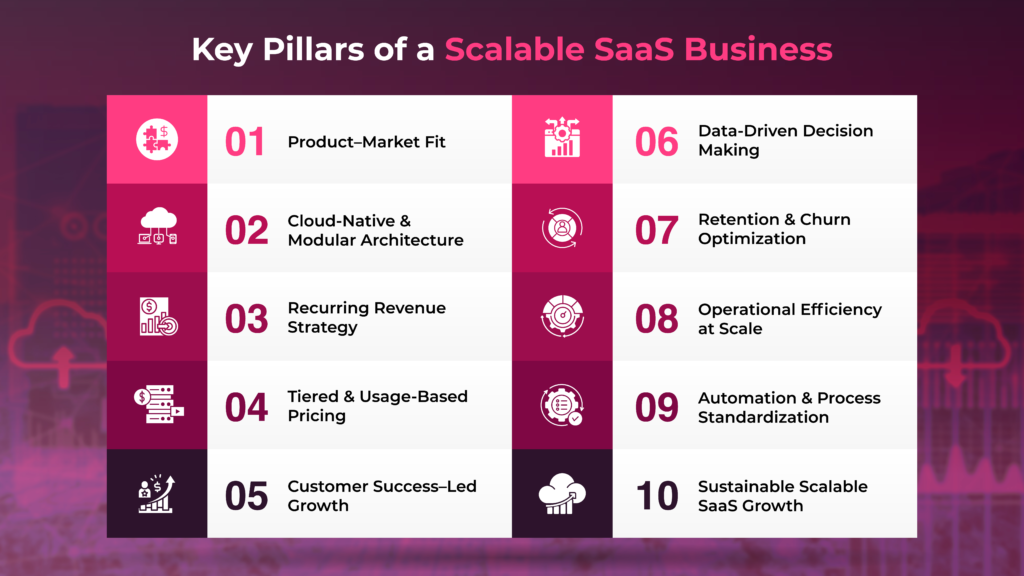
4. Customer Success as a Growth Engine
Scalable growth is not only driven by marketing and sales. Customer success plays a central role in reducing churn and increasing lifetime value.
Industry leaders treat customer success as a revenue-generating function rather than a support department. Proactive onboarding, usage analytics, and engagement strategies help customers extract maximum value from the platform.
When customers succeed, they renew subscriptions, upgrade plans, and become advocates. This reduces acquisition costs and strengthens the overall SaaS business model.
5. Data-Driven Decision Making
The most successful Scalable SaaS companies rely heavily on data.
Metrics that guide strategic decisions:
- Monthly Recurring Revenue
- Customer Acquisition Cost
- Customer Lifetime Value
- Churn Rates
Leaders use analytics not only to measure performance but to predict trends and identify growth opportunities. Automation tools and AI-driven insights further enhance decision-making accuracy.
For SaaS for startups, establishing a data culture early helps prevent reactive management and supports confident scaling.
6. Balancing Growth with Operational Efficiency
Rapid growth can strain teams and processes. Industry leaders emphasize operational efficiency to maintain profitability during expansion.
Standardized workflows, automation tools, and cross-functional collaboration ensure that scaling does not create internal bottlenecks. A Scalable SaaS organization builds systems that grow without proportionally increasing costs.
Sustainable scaling is about smart growth, not just fast growth.
Final Thoughts
Building a Scalable SaaS business requires more than a strong product idea. It demands strategic planning, scalable architecture, intelligent pricing, customer-centric processes, and disciplined execution.
Industry leaders consistently demonstrate that sustainable growth comes from aligning technology, operations, and customer value into a cohesive model. Whether launching SaaS for startups or expanding an established platform, the principles remain the same: focus on retention, optimize revenue models, leverage data, and design systems that scale effortlessly.
Ready to take your SaaS business to the next level? At Invisia Soft, we specialize in helping businesses scale effectively and efficiently.
Let’s connect and explore how we can turn your growth ambitions into reality!